Rosemary Oil vs. Minoxidil: What Does the Research Show?
The short answer
One RCT found rosemary oil equivalent to 2% minoxidil at 6 months.
The Core Question
Rosemary oil has been promoted as a natural substitute for minoxidil, largely based on a single 2015 clinical trial. Before making that comparison, it is worth being precise: which minoxidil? There are two FDA-approved topical concentrations (2% and 5%), and their efficacy differs by approximately 45%. The research context determines the conclusion.
What the Head-to-Head Research Actually Says
The Panahi 2015 RCT: Rosemary vs. 2% Minoxidil
The only published head-to-head randomized controlled trial is by Panahi et al. (2015), published in Skinmed (PubMed PMID 25842469). Study design:
- Population: 100 patients with androgenetic alopecia (AGA)
- Groups: Rosemary oil (n=50) vs. 2% topical minoxidil (n=50)
- Duration: 6 months, with assessments at baseline, 3 months, and 6 months
- Primary outcome: Hair count via standardized microphotography
Results:
- At 3 months: No significant change in hair count in either group (p > 0.05)
- At 6 months: Both groups showed statistically significant increases in hair count from baseline
- Between-group comparison at 6 months: No statistically significant difference — equivalent outcomes
- Scalp itch was significantly more frequent in the minoxidil group than the rosemary group
What this trial proves: Rosemary oil is statistically as effective as 2% minoxidil for AGA at 6 months.
What this trial does not prove: Equivalence to 5% minoxidil, which is the current clinical standard. This is a critical limitation.
The Network Meta-Analysis: Rosemary vs. 5% Minoxidil
A 2025 systematic review and network meta-analysis (PMC12386765) compared conventional and non-conventional OTC treatments for male AGA. Findings relevant to this comparison:
- 5% topical minoxidil had the highest SUCRA score (99.8%) among OTC treatments
- 5% minoxidil was significantly more effective than rosemary: MD = 19.53 hairs/cm² (95% CI: 6.52–32.68 hairs/cm²; p < 0.05)
This quantifies the gap: rosemary is not equivalent to 5% minoxidil.
The Rosmagain 2025 RCT: Rosemary vs. Coconut Oil (Not Minoxidil)
A 2025 double-blind, three-arm, placebo-controlled trial (PMC12256010) demonstrated significant improvements in hair growth rate (+57.7%), thickness (+68.7%), density (+32.2%), and hair fall reduction (>40%) with rosemary-blend oils vs. coconut oil. This confirms robust biological activity but does not extend the head-to-head minoxidil comparison.
Mechanism of Action: How They Work Differently
Understanding the mechanisms explains why these two options are complementary, not interchangeable.
| Mechanism | Rosemary Oil | Minoxidil |
|---|---|---|
| 5α-Reductase inhibition (DHT block) | Yes — 12-methoxycarnosic acid | No |
| Potassium channel opening | No | Yes — primary proposed mechanism |
| VEGF upregulation (angiogenesis) | Indirect (via carnosic acid antioxidant) | Direct — well documented |
| Anagen phase prolongation | Yes (indirect, via DHT reduction) | Yes (direct mechanism) |
| Scalp microcirculation improvement | Yes — vasodilatory via apigenin-type flavonoids | Yes — vasodilatory |
| Anti-inflammatory at follicle | Yes — carnosic acid, rosmarinic acid | Limited evidence |
| Bioactivation required | No | Yes — requires follicular sulfotransferase (SULT1A1) to form active minoxidil sulfate |
Key insight: Rosemary addresses DHT-driven miniaturization; minoxidil bypasses DHT and directly reactivates follicles. Used together, they address the condition from complementary angles — though no RCT has studied the combination.
Side Effect Profile Comparison
| Side Effect | Rosemary Oil (diluted) | Minoxidil 5% Solution |
|---|---|---|
| Scalp itch | Mild, transient | Common — documented in Panahi trial (more frequent) |
| Scalp dryness or flaking | Uncommon | More common with alcohol-based solutions |
| Initial shedding | Not well documented | Well documented (telogen effluvium in first 2–8 weeks) |
| Contact dermatitis | Possible (patch test recommended) | Possible (propylene glycol in solution formulation) |
| Systemic absorption / side effects | Very low — essential oil diluted topically | Low but documented — rare facial hair growth, low blood pressure at high doses |
| Hair color/texture change | Rare | None documented |
| Regrowth reversal on discontinuation | Yes — results reverse with cessation | Yes — reversal within 3–6 months of stopping |
Regulatory Status
| Factor | Rosemary Oil | Minoxidil |
|---|---|---|
| FDA approval for AGA | No | Yes (2% solution for women 1992; 5% solution for men 1997; 5% foam 2006) |
| Regulated as | Cosmetic ingredient | Over-the-counter drug |
| Labeling requirements | None for hair growth claims | FDA-regulated OTC drug labeling |
| Quality control | Variable by manufacturer | Standardized |
Minoxidil's OTC drug status means the FDA has reviewed and approved its efficacy and safety claims for AGA. Rosemary oil's cosmetic status means no such regulatory review has occurred for hair growth; products cannot legally make drug-level efficacy claims.
How to Choose: Decision Framework
Rosemary Oil May Be the Better Choice If:
- You have mild AGA and want a natural, drug-free first-line option
- You have experienced scalp irritation with minoxidil (itch, dryness, flaking)
- You are looking to complement an existing hair loss regimen
- You prefer the tolerability profile and lower systemic absorption risk
- Cost is a significant consideration (DIY rosemary dilution is inexpensive)
Minoxidil (5%) May Be the Better Choice If:
- You have moderate-to-severe AGA with significant miniaturization
- You want the most evidence-backed OTC option with the largest RCT dataset
- You want FDA-approved standardized formulation
- You have previously responded well to minoxidil
- Speed of response matters (5% minoxidil typically shows changes faster than rosemary)
Consider Seeing a Dermatologist If:
- You have been using either treatment for 6 months without improvement
- Your hair loss is rapid, patchy, or accompanied by scalp symptoms (pain, scaling, redness)
- You are considering oral minoxidil or prescription options (finasteride, dutasteride)
- There is any possibility that a systemic cause (thyroid, iron deficiency, hormonal disorder) is contributing
See the Hair Ingredients & Treatments hub for a full overview of evidence-based options, or Best Ingredients for Hair Growth for a comparison across the full range of scalp actives.
Can You Use Both Together?
There is no documented pharmacokinetic interaction between topical rosemary oil and topical minoxidil, and their mechanisms address different aspects of the condition. A practical protocol if using both:
- Apply minoxidil in the morning and allow to dry fully (20–30 minutes)
- Apply diluted rosemary oil (1–3% in carrier oil) in the evening or overnight
- Use this combination consistently for at least 6 months before evaluating response
No RCT has studied this combination. The approach is rational given the complementary mechanisms but remains evidence-free as a combination.
Products that fit this guide
Picked by code from each product's full ingredient list.
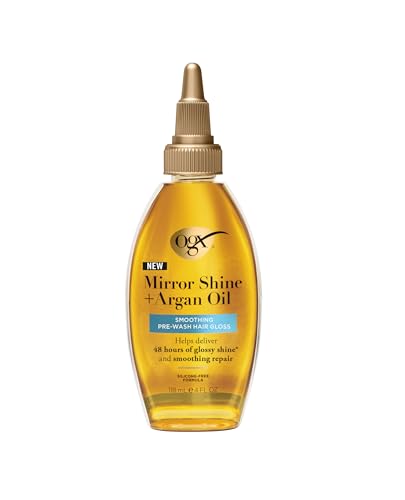
OGX
Mirror Shine + Argan Oil Pre-Wash Hair Gloss
hair oil · 118 ml · 8 ingredients
- No essential oils

Balea
Professional Hair Oil Dream Curls 1 x
hair oil · 100 ml · 23 ingredients
- No essential oils
- With vitamin e

OGX
Bond Protein Repair Sealing Hair Serum
hair oil · 50 ml · 25 ingredients
- No essential oils
- With glycerin
- With panthenol
- With keratin

Aussie
Reconstructor Hair Oil
hair oil · 100 ml · 12 ingredients
- No essential oils
Frequently asked questions
Is rosemary oil as good as minoxidil according to 2026 evidence?
One 2015 RCT found rosemary oil equivalent to 2% minoxidil at 6 months in AGA patients. However, a 2025 network meta-analysis established that 5% minoxidil — the current standard — outperforms rosemary by approximately 19.5 hairs/cm². Rosemary is competitive with the lower 2% concentration and is a legitimate evidence-based option, but the full body of evidence positions 5% minoxidil as more effective for established AGA.
Which has fewer side effects — rosemary oil or minoxidil?
In the 2015 head-to-head RCT, scalp itch was significantly more frequent in the minoxidil group. Rosemary oil (properly diluted) is generally better tolerated for scalp use. Minoxidil 5% solution also commonly causes initial shedding (telogen effluvium) in the first 2–8 weeks, while rosemary-associated shedding is not well documented. However, minoxidil foam formulations (alcohol-free) have improved the tolerability of minoxidil significantly.
Do you have to use rosemary oil or minoxidil forever?
Both require continuous use to maintain results. Stopping minoxidil results in reversal of gains within approximately 3–6 months, as the follicles return to their pre-treatment state. Rosemary oil is expected to behave similarly, given it works via DHT modulation and scalp environment improvement — when the stimulus is removed, miniaturization resumes. Neither is a cure for androgenetic alopecia.
Can I use rosemary oil if minoxidil stopped working for me?
There is no clinical data on rosemary oil in true minoxidil non-responders. About 30–40% of AGA patients show limited or no response to topical minoxidil, sometimes linked to low follicular sulfotransferase activity. Since rosemary works via a different mechanism (5α-reductase inhibition rather than potassium channel modulation), it is biologically plausible that it may offer benefit in this group — but this is theoretical, not proven.
Is minoxidil safe long-term?
Topical minoxidil has a well-characterized long-term safety profile from decades of post-market use and clinical data. Systemic absorption from topical application is approximately 1.4%, making systemic side effects uncommon. The main documented concerns are scalp irritation and rare hypertrichosis (facial hair growth). Oral minoxidil (off-label, lower doses) has a different risk profile and should only be used under medical supervision.
Health information, not medical advice.
Beauty Comparison is an independent editorial publication. This page is researched and sourced to the authorities listed below, but it is general information — not a diagnosis or a substitute for personalised advice from a qualified doctor, dermatologist or pharmacist. If your symptoms are severe, spreading, painful, or not improving, see a healthcare professional.Sources
- 01Rosemary oil vs minoxidil 2% for the treatment of androgenetic alopecia: a randomized comparative trial — PubMed / Skinmed, 2015-01-01. Only head-to-head RCT (n=100, 6 months): rosemary oil equivalent to 2% minoxidil for hair count at 6 months; significantly less scalp itch in rosemary group.
- 02Comparative Effect of Conventional and Non-Conventional Over-the-Counter Treatments for Male Androgenetic Alopecia: A Systematic Review and Network Meta-Analysis — PubMed Central / PMC, 2025-01-01. 5% minoxidil significantly outperformed rosemary in network meta-analysis (MD = 19.53 hairs/cm², p<0.05); 5% minoxidil had highest SUCRA score (99.8%) among OTC AGA treatments.
- 03Minoxidil - StatPearls - NCBI Bookshelf — NCBI / StatPearls. Minoxidil mechanism (potassium channel opening, VEGF induction, anagen prolongation), FDA-approval history (1987 topical; 2% for women 1992; 5% for men 1997), and prodrug activation via follicular sulfotransferase (SULT1A1).
- 04A randomized clinical trial of 5% topical minoxidil versus 2% topical minoxidil and placebo in the treatment of androgenetic alopecia in men — PubMed, 2002-09-01. 48-week RCT (n=393): 5% minoxidil produced 45% more hair regrowth than 2% minoxidil; earlier response with 5% — establishing the clinical gap between the two concentrations.
- 05An Overview of Commonly Used Natural Alternatives for the Treatment of Androgenetic Alopecia, with Special Emphasis on Rosemary Oil — PubMed Central / PMC, 2024-11-01. Comprehensive review of rosemary oil mechanisms: 5α-reductase inhibition by 12-methoxycarnosic acid, scalp microcirculation improvement, anti-inflammatory and antioxidant effects via carnosic and rosmarinic acids.
- 06Rosmagain™ as a Natural Therapeutic for Hair Regrowth and Scalp Health: A Double-Blind, Randomized, Three-Armed, Placebo-Controlled Clinical Trial — PubMed Central / PMC, 2025-01-01. Rosemary-blend oils significantly outperformed coconut oil control for hair growth rate, thickness, density and hair fall at 90 days (all p<0.0001) — confirms biological activity but not head-to-head vs. minoxidil.